EMRate Median Comparison - Western vs. Eastern Europe
Median = EMRate Average over time (%)
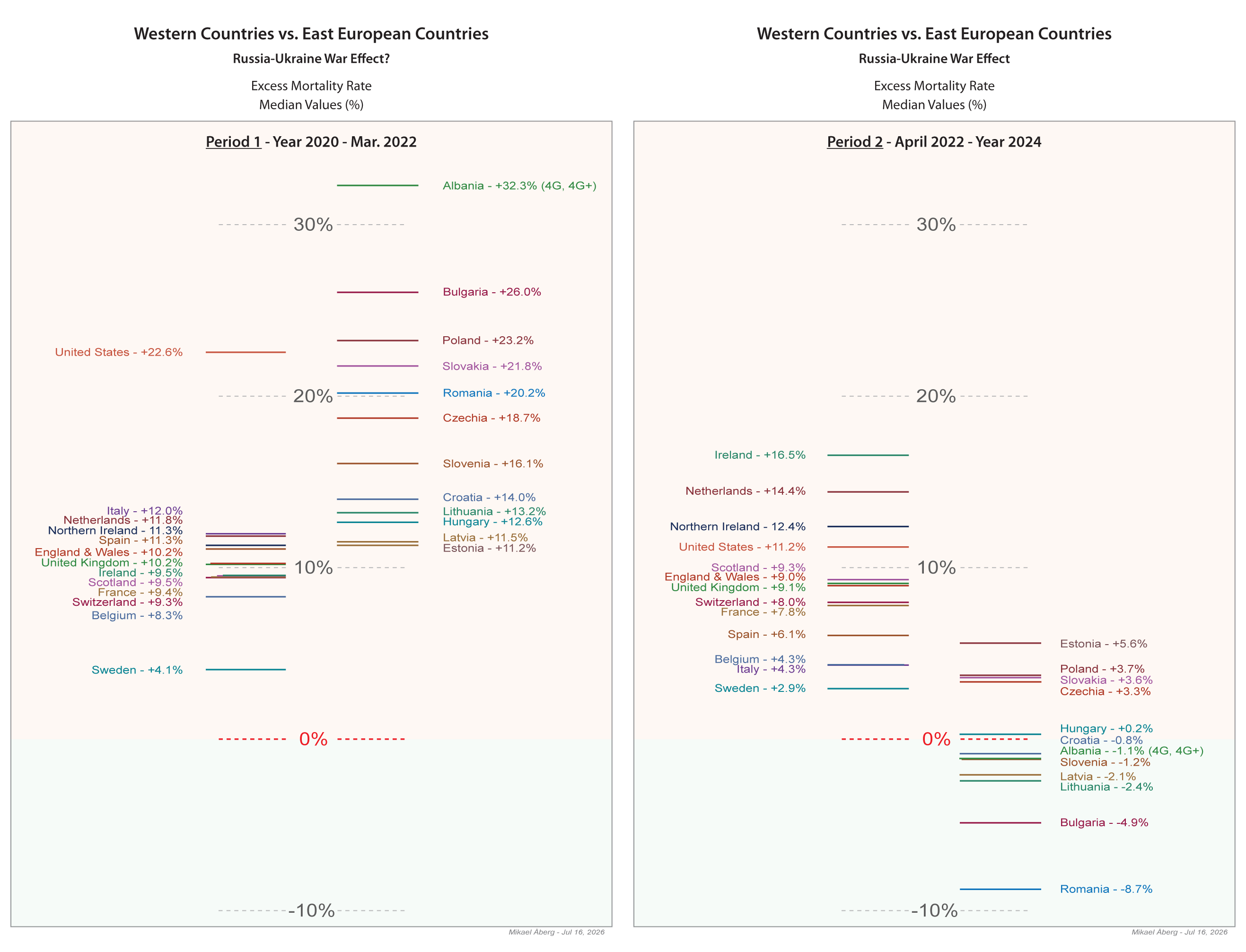
This section presents the median values [excess mortality] for 25 countries for the periods 2020–March 2022 (Period 1) and April 2022–2024 (Period 2). These data show period-dependent differences in mortality between Western countries and Eastern Europe.
PERIOD 1.
The difference in excess mortality between the Western and Eastern blocs is striking, as is the distribution [dynamics] within the blocs. This is likely due to the less developed mobile infrastructure in Eastern Europe; in order to keep reasonably pace with the West, it was necessary to maintain a very rapid pace in the development of mobile networks.
Countries that stand out within the various blocs are the United States and Sweden in the West, and Albania in the East.
Albania: The country with the weakest starting point in terms of mobile infrastructure focused on a very rapid rollout of the 4G/4G+ network in order to later introduce the 5G standard.
United States: A large country [in terms of area and population] with perhaps the most aggressive 4G+/5G deployment strategy among these countries, featuring early implementation of millimeter waves, 3G refarming, and other advanced technologies.
Sweden: A relatively large country [in terms of area] with a relatively small population [unevenly distributed], which has proven to pose challenges in the implementation of new technologies. Consequently, from the end of Period 1 onward, there has been a major focus on networks using longer wavelengths [lower bandwidth] in order to reach as many users as possible. A relatively large country [in terms of area] with a relatively small population [unevenly distributed], which has proven to pose challenges in the implementation of new technologies. Consequently, from the end of Period 1 onward, there has been a major focus on networks using longer wavelengths [lower bandwidth] in order to reach as many users as possible.
Period 1: Year 2020-March 2022 _______________ Period 2: April 2022-2024 |
|||||
 |
|||||
|
|
|
|
||
PERIOD 2. (After the start of the Russia-Ukraine war)
Eastern European countries: During this period, the restrictions associated with the “U.S. Security Agreement” had a negative impact on Eastern Europe’s ongoing mobile infrastructure expansion. Eastern European countries, which were more dependent on undesirable Chinese infrastructure and hardware in their mobile networks, have significantly lower mortality rates than Western countries, and this trend has continued to the present [Dec. 2025]. It is also interesting to note that, following the blockade of Chinese mobile infrastructure and hardware, mortality rates became more consistent—with smaller differences among Eastern European countries—as the 4G+/5G expansion came to a halt.
Albania: The country with the worst starting point in terms of mobile infrastructure and the second-highest excess mortality rate during the previous period has seen its excess mortality rate drop to a relatively low -1.1% following the blockade of Chinese mobile infrastructure. This is a figure that none of the analyzed Western countries comes close to; it is likely one of the lowest median values achievable overall during the period, and it is clear that most Eastern European countries have had low and even lower median figures.
Western Countries: These countries still have very high median figures, with few exceptions, and the spread in mortality rates has, as expected, increased—a natural consequence of geographical differences, topography, population density, and economic conditions, as well as some impact from the restrictions related to the “U.S. Security Agreement” mentioned above.
A similar trend would have been expected in Eastern Europe if 4G/5G deployment had continued at the same pace—that is, if 4G+/5G technology had continued to expand in a similar way as in western countries.
"Close Window"